
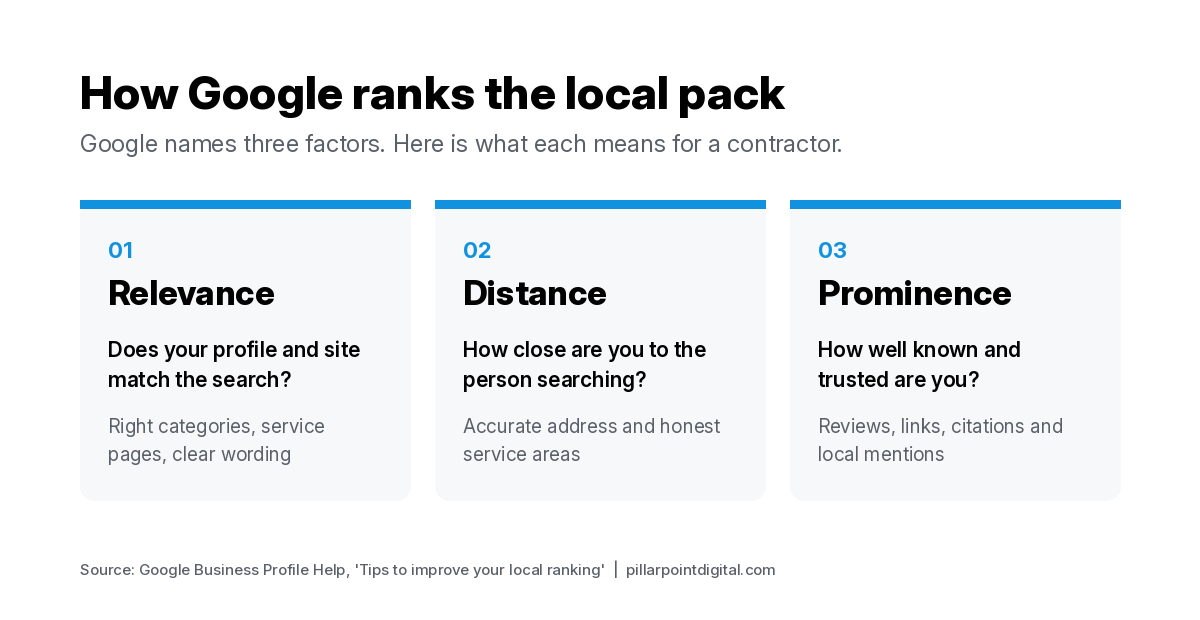
Local SEO for contractors comes down to three things Google says it uses to rank local results: relevance, distance and prominence. In practice that means a fully built Google Business Profile, one page on your site for each service you want calls for, and a steady flow of real reviews. Most contractors have one of the three. Very few have all of them.
We’re a small agency in Fort Wayne, and a good share of our work is with trades businesses, the roofers, remodelers and home service crews who don’t have time to think about search engines because they’re on a job site. So this isn’t a theory piece. It’s the order we’d do things in if you handed us your business on Monday morning.
What is local SEO for contractors, in plain terms?
It’s the work that decides whether you show up when someone near you searches “roof repair near me” or “kitchen remodeler Fort Wayne.” Those searches usually show a map with three businesses under it, then the regular results below. Getting into that map pack is the whole game for most contractors, because that’s where homeowners tap the call button.
Google’s own help page on local ranking lists the three factors plainly. Relevance is how well your profile matches what was searched. Distance is how far you are from the searcher, or from the location they typed. Prominence is how well known your business is, which Google says draws on reviews, links and articles about you across the web.
You can’t move your shop closer to every customer. You can control the other two, and that’s where the effort should go.
Start with your Google Business Profile, not your website
If you only have a few hours this month, spend them here. Your profile is what shows in the map pack, and for a lot of homeowners it’s the only thing they look at before calling.
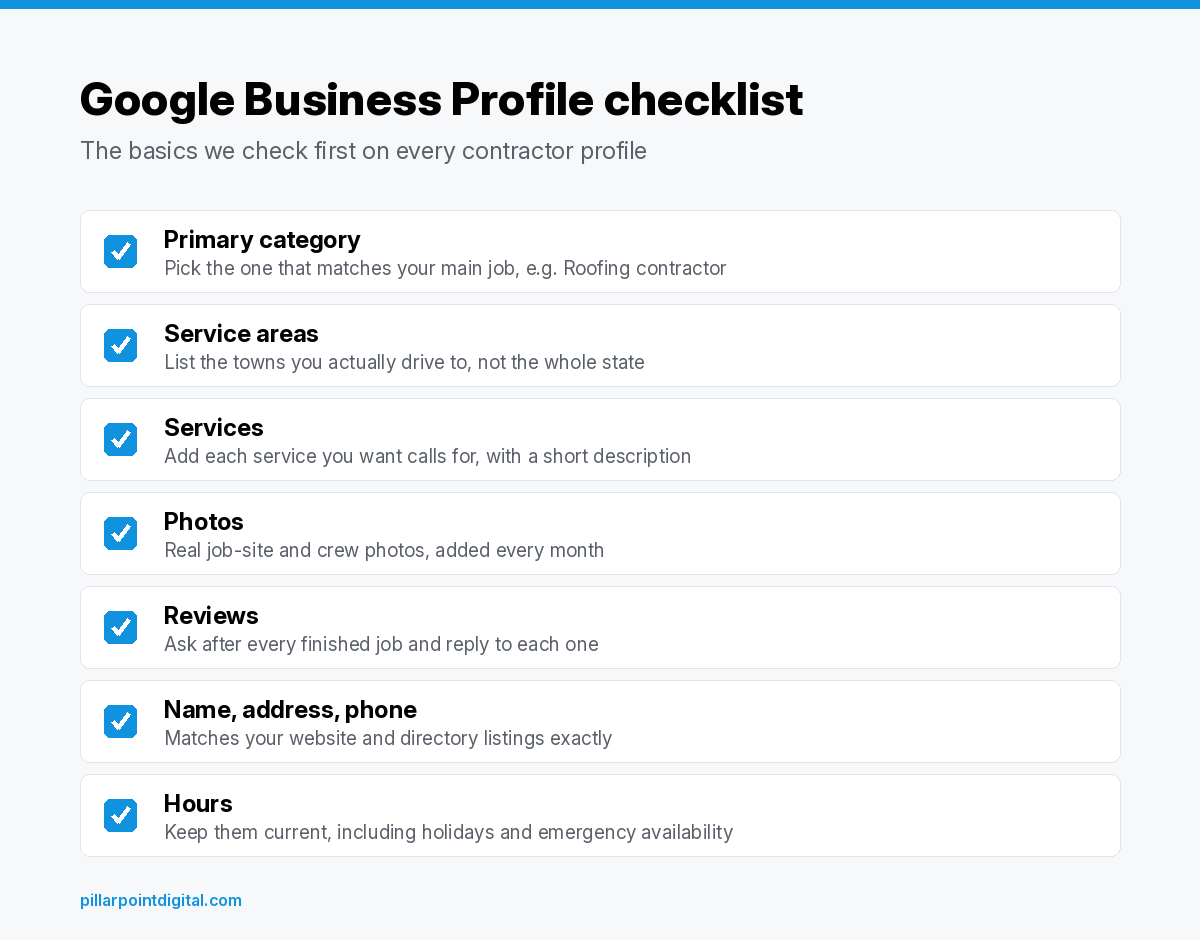
Here’s what we check first on every contractor profile:
- Primary category. This is the single most important field. “Roofing contractor” and “General contractor” pull very different searches. Pick the one that matches the work you most want, then add secondary categories for the rest.
- Service area, not a street address (if you go to customers). Google’s guidelines say service-area businesses that don’t serve customers at their location should hide the address and list the areas they cover instead. Showing a home address you don’t receive customers at can get a profile suspended, and we’ve seen that happen to more than one trades business that set things up years ago without knowing the rule.
- Services list. Fill it out line by line. Add the specific jobs people search for, like “gutter replacement” or “storm damage repair,” not just the umbrella term.
- Photos of your actual work. Job site photos, your trucks, your crew in branded shirts. Stock images do nothing for trust, and homeowners can usually tell.
- Hours and phone. It sounds obvious. It’s also the most common thing we find out of date.
One opinion we’ll stand behind: don’t stuff your city name into the business name field. It might bump you for a while, but it breaks Google’s guidelines, and competitors can and do report it.
Build one page for every service you want calls for
This is where most contractor websites fall short. They have a home page, an about page, and a single “Services” page that lists eight things in one paragraph. Google has nothing specific to match against, so it ranks the site for almost nothing.
The fix is simple, though it takes some writing. Give each main service its own page. A roofer might have separate pages for roof replacement, roof repair, storm and hail damage, gutters, and commercial roofing. Each page should say what the job involves, what a homeowner should expect on timing and process, what areas you cover, and how to get an estimate.
A few things make these pages work harder:
- Put the service and your main city in the page title and the main heading, written the way a person would say it.
- Answer the questions you get on the phone every week. How long does a tear-off take? Do you handle the insurance claim? Those answers are exactly what people search.
- Add photos from real jobs on that service, with a short caption about the job.
- Link each service page to your contact page and back to your home page, and make the phone number tappable on mobile.
Should you build a page for every town you serve? Only if you can say something real about each one, like jobs you’ve done there or local permit quirks. Twenty near-identical town pages with the name swapped out is the kind of thing Google’s spam policies call out as doorway pages, and it tends to drag the whole site down.
Reviews: the part you can’t fake and shouldn’t try to
Reviews feed the prominence factor, and they’re also what tips a homeowner from looking to calling. The contractors who win on reviews aren’t doing anything clever. They just ask every time.
What works for the crews we’ve seen do it well is asking at the moment the customer is happiest, which is usually when the job is cleaned up and they’re looking at the finished work. Send a text that day with the direct review link from your Business Profile. Keep it short and personal.
There are two rules worth knowing, because breaking them can get reviews removed. Google’s policy prohibits offering anything in exchange for reviews, so no discounts or gift cards. It also prohibits selectively asking only happy customers, a practice usually called review gating. Ask everyone, and reply to every review, including the bad ones, calmly and specifically.
Get your name and number consistent everywhere
Your business name, phone number and service area should read the same on your website, your Google profile, Facebook, Yelp, Angi, the BBB, and any supplier or manufacturer directories you’re listed in. If you changed phone numbers or rebranded at some point, old listings with the wrong details are probably still out there.
This won’t make you rank by itself. It does remove a reason for Google to be unsure you’re one business, and it stops customers from calling a dead number.
Where Local Services Ads fit in
If you’re in a trade Google supports, Local Services Ads show above the map pack with a “Google Guaranteed” or “Google Screened” badge, and you pay per lead rather than per click. They’re not SEO, but we bring them up because contractors often ask whether they should do one or the other.
Our view is that they work well together. Ads can bring calls in this month while the organic work builds. The reviews you collect help both, since they show on your ads and your profile. If you want a second opinion on what you’re already spending, our Google Ads audit is a good place to start.
How long does local SEO take for a contractor?
Profile fixes like the right category, a hidden address and a full services list can change how you show up within a few weeks. New service pages usually take a few months to settle into rankings. Reviews are a steady climb with no shortcut. We’d tell any contractor to plan on a season, not a week, and to judge it by calls and booked estimates instead of rankings alone.
What we’d do first if you hired us Monday
If we sat down with your business, this is the order we’d work in. First the Business Profile cleanup, because it’s fast and it’s what shows in the map. Then a review routine your office can run without thinking about it. Then service pages, starting with the job that makes you the most money. Listings cleanup happens in the background along the way.
If you’d rather have someone look at where you stand today, we run a free SEO audit and you can see how we approach local SEO for service businesses.
FAQ
Is local SEO worth it for a small contractor?
For most trades, yes, because the people searching are often ready to hire, and the map pack is free to show up in. The cost is mainly time or an agency fee, and the payoff is calls that don’t depend on buying every lead.
Do I need a website, or is a Google Business Profile enough?
A profile alone can get you some map visibility, but a website with a page for each service gives Google more to match against and gives homeowners somewhere to check you out before they call. We’d treat the profile as step one and the site as what keeps you ranking.
Can I list my home address on my Google profile?
If customers don’t come to your home, Google’s guidelines say to hide the address and set a service area instead. Listing a home address you don’t serve customers at risks a suspension.
How many reviews do I need?
There isn’t a magic number. What matters is that you have more recent, real reviews than the other contractors showing up for the same searches in your area, and that you keep getting them every month.
Should I do local SEO or Google Ads?
They do different jobs. Ads can bring calls in right away, while SEO builds visibility you don’t pay for per click. Many contractors run both and lean on ads less as organic calls grow.